

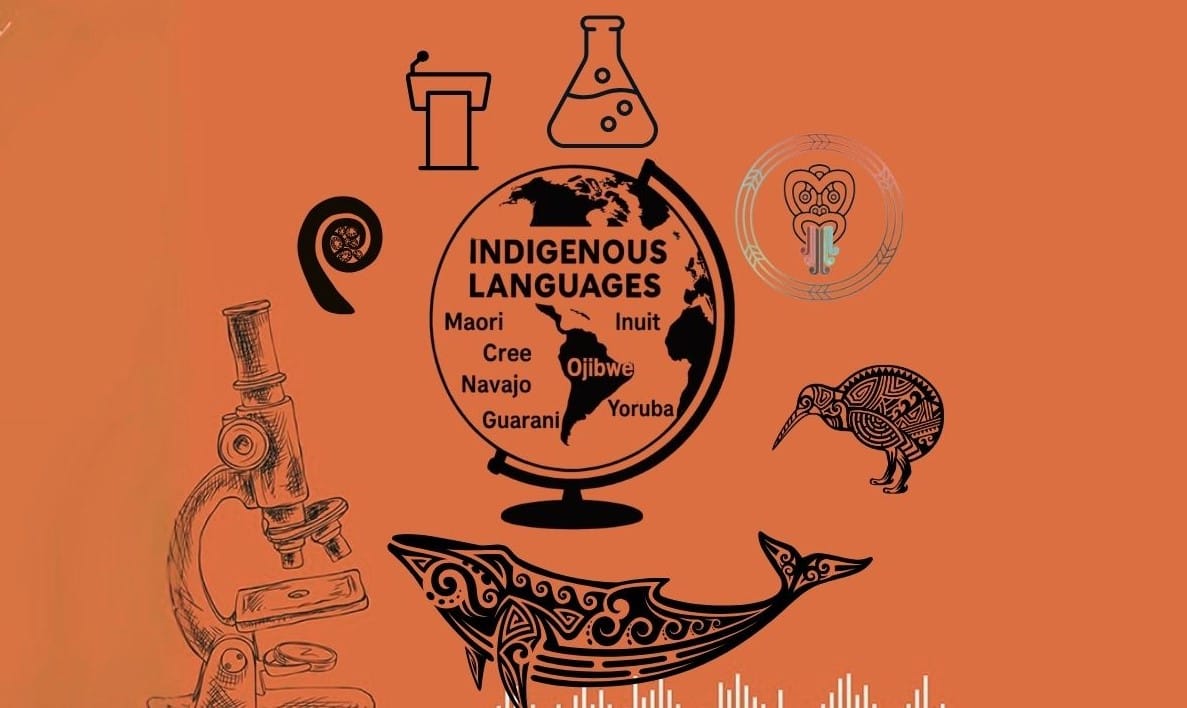
Dr Linda Hernandez Duran & Dr Daniel Esguerra Rodríguez
Every two weeks, an Indigenous language dies with its last speaker. When a language disappears, we lose not only words but also stories that cannot be translated, medicines that have no other name, irreplaceable ancestral knowledge, ways of loving, of grieving, and of understanding the universe that exist nowhere else on Earth.
When we hear about the extinction of ancestral languages and of Indigenous peoples, for many it is shocking — but often we don’t grasp what it actually means for a language to vanish.
For many Indigenous peoples around the world, language carries a singular meaning, because it becomes not only the way they communicate but also how they see the world. As a Spanish speaker, I never had the chance to learn the language of my Indigenous ancestors. Spanish is my language, and through it I express my feelings and my anxieties; I use words to advocate for my rights and to write poetry, because in English the verbs and phrases don’t come naturally — at least not to me.
In this blog we explore how science and language can become engines of change in the paradigm of knowledge, drawing on the work and perspectives of two remarkable women. Te Awa Puketapu is a community leader, activist, politician, and defender of her native Māori language in Aotearoa, New Zealand. As part of the first generation of the Kōhanga Reo project, she advocates for the continuity of her language — the meaning of that language, and how it shapes Māori culture and its connection to the world.
Dr. Valeria Ramírez — biologist, amateur linguist, and science communicator — tells us how the homogenisation of language in science drives inequity, opening gaps that bury the science produced in countries where English is not spoken.
This discussion grows out of the reflections and questions we raised in our podcast interviews:
Te Awa Puketapu
Dr. Valeria Ramírez
The agreement
The Māori are the Indigenous people of Aotearoa, New Zealand. They arrived from Polynesia centuries before the Europeans and organised themselves into hapū and iwi — extended families and tribes — led by their rangatira, their chiefs. In the early nineteenth century, British whalers, traders, and settlers began to arrive; they bought land through dubious dealings and answered to no authority: there was no law to keep them in check. In 1835, the rangatira signed He Whakaputanga, a declaration of independence stating in writing that authority over their territories rested with them alone. For that reason, five years later, the Crown could not simply take the country: it needed an agreement. That agreement was the Treaty of Waitangi, signed in 1840. And from the Māori point of view the purpose was clear: that the Queen would control her own subjects, and that the two peoples could, as Te Awa puts it, “live together in this country in harmony and reciprocity.”
It was not a surrender of sovereignty; it was an agreement to coexist. But the treaty was drafted in two days and translated overnight, and it ended up in two versions that did not say the same thing. The English one said the Māori ceded “sovereignty.” The Māori one — the version the vast majority of the chiefs signed, the only one they could read — said they kept their tino rangatiratanga, their authority, and handed the Queen only kāwanatanga: a word invented from “governor,” to govern her own.
“There’s a word in the Treaty of Waitangi. There’s the word kāwanatanga — no, actually it was the word rangatiratanga. And the way that word is interpreted through our lens is not the same way it’s interpreted from the British side, or from the English language. And that word, because of that misunderstanding, has created a huge division in New Zealand over the last one hundred and eighty-five years, about whether or not Māori ceded sovereignty.”
In 2014, the Waitangi Tribunal ruled in favour of the Māori people: sovereignty was not ceded. But by then almost two centuries had passed, and an entire country had been built on the English translation: land confiscated, and laws that barred Māori healers from practising, along with the punishment of children for speaking their language at school. A single mistranslated word about sovereignty ended up almost destroying the Māori language, their way of life, and — very nearly — the Māori people themselves.
“There was a law called the Tohunga Suppression Act. Because of that law we couldn’t keep practising our own medicinal and healing practices. And if we go back to the Treaty of Waitangi, that was exactly one of the things that should have been protected. But the laws kept coming to stop that from happening. Same with the schools. There was the Native Schools Act, which came in in eighteen sixty-eight, I think. That meant my great-grandmother, who went to a native school, couldn’t speak Māori. She’d have to learn English and go home and speak Māori. And corporal punishment was allowed. Those are some of the breaches and the very deliberate moves that were made as a practice of assimilation and colonialism against our people, even with the Treaty in place.”
The nest: kōhanga reo
Jail was the punishment people faced for speaking Māori.
“My first language is Māori. My grandmother would only speak to me in Māori until I was about sixteen. And it was probably quite a risk, too. Because I remember a story she used to tell — that she’d go to jail. If she had to go to jail for teaching Māori to the young, she’d do it. That was a sacrifice not just she but, I imagine, so many other people were willing to make.”
In the 1970s, the Māori language was on the brink of extinction. Te Awa’s grandfather, Dr. Ihakara “Kara” Puketapu, had been inspired years earlier by watching trilingual children in the United States, when he studied at the University of Chicago and later in New Mexico. As he himself would say, that image stayed with him for a very long time. Back home, and as Secretary of Māori Affairs, he convened the meetings that would pave the way for a movement that changed everything.
In the late 1970s there were marches and gatherings across the country to save the language. At one of them, at the marae in Waiwhetū, a Tainui kaumātua gave a name to what was coming.
“Kōhanga is a nest, a bird’s nest. And reo is the language. So: the nest — a language nest.”
In 1982, Te Awa’s grandmothers, Jean Puketapu and Dame Iritana Tāwhiwhirangi, started kōhanga reo, a movement to revitalise the language by teaching Māori children their native tongue at home. It was a hard task, with little or no government support. Children were the key to preserving the language — they would speak Māori again. Te Awa belongs to the first generation of the nest — those who recovered what had been taken from their parents.
Jean Puketapu and Iritana Tāwhiwhirangi travelled the country, convincing communities and spreading the idea.
“They’d travel all around New Zealand trying to encourage communities: look at this, look at this, we need to do this.”
And it worked. The nest spread across New Zealand, and then out into the world: Hawai’i copied it, and in Canada it served as a model for languages that were fading, such as Mohawk.
Women, language, and the perception of the world
For the Māori, women play a central role, because they are the ones who nurture and, with love, passion, and compassion, lead their family and their community. The fierceness of being a woman, a mother — the fire that protects not only her family but her community. It is the grandmothers who nurture and who carry the message and the inheritance of the language.
“My grandfather always used to say: if you want something to get done, there has to be a woman.”
And it is written into practice:
“When you go into a marae, you can’t actually enter or see that marae until a woman has called you on. And if you’re not called on, you have to wait outside. It’s quite interesting, because when you look at our practices, it is quite a male-dominated practice … but what sits behind everything, and without which nothing can happen, is the woman.”
marae: the Māori sacred communal ground — an enclosure with a carved meeting house (the wharenui) and a ceremonial forecourt (the marae ātea). It is where the community welcomes visitors, celebrates, debates, and mourns its dead.
The men spoke. The women acted. When, in 1975, the Māori marched a thousand kilometres to Parliament for their land, at the front walked Dame Whina Cooper, an eighty-year-old grandmother whom they called the Mother of the Nation. In the language marches, another grandmother walked front and centre. Always a grandmother in front, carrying the land or the language to the generation coming behind.
In many cultures and peoples, the world is perceived through songs, stories, and metaphors, through places and landscapes — as it is in Māori.
Te Awa explains that Māori is thought in a descriptive way, rich in metaphor and oratory: one speaks by drawing on the forests, the oceans, the land. But when she explains how a life is named, the demonstration becomes physical.
“When we’re born, the word for being born is whānau. And whānau is to be born, but it also means our family. And when a woman is carrying us in the womb, it’s called hapū. So when someone is pregnant, they’re said to be hapū. And then when we die, we go back into the whenua, which is what we call our land — but our placenta is also called whenua. So when we’re born, the placenta is buried into the ground. And then our bones are called kōiwi. And that’s where the notion of iwi comes from. And iwi means tribe.”
To be born and family are the same word. To be pregnant and to be a sub-tribe are the same word. Land and placenta are the same word — and that is why the placenta is buried, because it was already called land before it was buried. Bones and tribe share a root.
In English, saying all of this would take several lines of explanation, and even then the essential thing would slip away. We separate what Māori keeps joined. For us, family goes on one side and birth on the other; land is one thing and the body another. The Māori language doesn’t have to explain that people come from the earth, because it says so in every word. That is what is lost when a language is lost: a connection to one’s surroundings, to one’s family, to the ties that bind us to this world.
“When we introduce ourselves — one of the things I didn’t do when I introduced myself at the start — we actually begin by introducing our mountain, our river, our land. First we draw the connection to our environment. We say our own name last, because it’s really the least important thing.”
Everything else follows from that. If you come from the land, you cannot stand above it. The principle is called kaitiakitanga: to be the caretaker — of people, but also of the world. And the god of the forest has a name, Tāne Mahuta, so that for Te Awa, walking into a forest and behaving badly is not damaging a resource: it is disrespecting a god. It is not something she learned as an adult. It is a gesture she repeated as a child, without thinking about it:
“I used to practise this always as a kid, and to me it was just second nature, it was simply what I had to do.”
“I’d never go into a forest without saying a prayer. I’d never deliberately damage a tree without saying a prayer, or without asking, if I needed something. I’d never do it without asking.”
“The land and all that is seen as a resource, as a mineral. But we don’t see it that way. We see it as us having the responsibility to take care of all of our gods, which is essentially our whole environment.”
She connects it to the floods hitting New Zealand today — the trees and the hills are sick from so much destruction, and they need time to heal.
A look towards the future
Thinking of all the struggles the Māori have gone through to save their language, one might imagine they belong to the past. And yet, while we were recording, the New Zealand government was pushing the Treaty Principles Bill, a project to redefine the principles of the Treaty.
“It seeks to redefine the principles of the Treaty of Waitangi to favour the narrative that we ceded sovereignty. And that hurts. That’s hard.”
One hundred and eighty-five years later, and ten years after a tribunal of the state itself ruled the opposite, the attempt is to fix the 1840 reading back into law. The wrong translation — this time on purpose.
Te Awa does not respond from the outside. She spent fourteen years in central government, and today she holds a Māori ward, a seat reserved on the council to represent Māori voices. That seat was put to a referendum, and her community — and all of Wellington — voted to keep it. Her method has a title, and it is that of her grandfather’s book: reform from within.
“Sometimes you have to be inside those systems to reform things.”
And she has a theoretical frame: reconciliation versus resurgence, a discussion she follows in Linda Tuhiwai Smith and Jeff Corntassel. Reconciling with the other party, yes, but without ceasing to practise resurgence: continuing to be, in daily practice, what the system tried to erase.
“Two generations ago, our grandparents went through the same thing, if not worse. So it’s a blip.”
And the best thing one can do about it, according to the Māori King, is simply to be Māori.
When we asked what sustains her, she didn’t talk about politics. She talked about children.
“I love seeing our children running around speaking our language to their parents, to their grandparents. I love hearing that.”
Behind every person who steps forward, she says, there are conversations, community, support: “with that one person come hundreds, if not thousands of people.”
And there is a date. In New Zealand, if you say 2040 to a Māori person, nothing needs explaining: it is the bicentennial of the Treaty, and the goal of an Aotearoa different from today’s.
“It’s been one hundred and eighty-five years. We’ve got through these things before. It’s just part of the journey.”
“Fight for what you need to fight for. Stand up for what you need to stand up for. But take care of yourself in that process.”
From how we perceive the world, to how we communicate science
Just as the attempt to censor or eliminate a language is a reflection of colonialism, the paradigm of scientific publishing and the metrics of productivity and impact are symptoms of the same illness, because they replicate practices that homogenise the language in which discoveries and debates are presented. In science, the problem is that English became the global language of the field, sidelining the multicultural scientific population and creating barriers to publishing and disseminating the science of each region.
In a multicultural world, for scientists who don’t speak a second language, or whose language is not English, this linguistic barrier becomes a form of discrimination, deepening inequity and disadvantage in a highly competitive society. As our guest Dr. Valeria Ramírez and her collaborators note, non-native English-speaking scientists tend to spend more time reading and writing papers in English than native speakers do. These inequalities also show up in the fact that studies by scientists from non-English-speaking countries are rejected more often, for reasons of language. Or at specialised conferences, where many students and researchers avoid oral presentations because of the language, on top of needing more time to prepare them.
The scientific publishing model exposes the biases that exist in a field where local science is relegated to second and third tier — even within the scientific evaluation systems of non-English-speaking countries — simply for not being published in English, in what are considered “prestige” journals. This local science, which in turn represents a vast body of information, is undervalued by the international scientific community yet is of great value for decision-making and for solving local and regional problems (Amano et al., 2023).
“Language is a cultural process that lets us observe the world. Languages are cultural processes that let us make observations of the world. So a person who speaks a different language from yours is not going to understand the world in the same way — and that’s beautiful; it shouldn’t be a problem, it should be something we embrace. That’s why it’s so important to care for languages, why it’s so important to revitalise languages that are about to die, because they hold thousands of years of knowledge about the world. They tell us about the creatures that live in a territory, about ideas of time, about ideas of space. And I think that clearly influences science, because if we did all of science in English, it becomes what has been called monolingual epistemologies. All knowledge comes from a single language, and so there are things that can no longer be named the same way, no longer observed, no longer felt the same way — and so we lose observations of the world.”
Valeria Ramírez’s quotes were translated from the original Spanish interview.
Publications in English, which in theory seek to put scientific advances within everyone’s reach, end up doing the opposite. They limit access to scientific knowledge to a privileged group of society — one not limited to native English speakers. Studies show that those who secure tenured research positions at U.S. universities mostly have parents with graduate degrees and come from higher socioeconomic positions (Morgan et al., 2022). These same researchers are the educators of the next generation of scientists. The dominant models of science education in Global North countries (many of them English-speaking) continue to be replicated in the education systems of non-English-speaking countries of the Global South.
“How do we make sure the kids are actually understanding, actually learning science itself? How do we give researchers the chance to be valued, even if they publish in their native language, or in languages other than English? These are things that I really don’t feel would require a scientific revolution to be possible.”
Indigenous and local knowledge tends to go unnoticed within a hegemonic system. So what remains for us, from whatever position we hold, is at least to question the privileges we enjoy or the inequalities we face — and how these positions are founded on structural practices that have led us to normalise them. What remains, too, is to demand of our institutions some measure of will, so as to avoid the loss of knowledge and the deepening of injustice.
References
https://therevelator.org/extinction-languages/
https://www.nationalgeographic.com/culture/article/maori-language-nest-model-new-zealand
https://journals.plos.org/plosone/article?id=10.1371/journal.pone.0238372
https://www.nature.com/articles/d41586-025-00157-5
https://pmc.ncbi.nlm.nih.gov/articles/PMC12838439/
Amano, T., Berdejo-Espinola, V., Akasaka, M. et al. The role of non-English-language science in informing national biodiversity assessments. Nat Sustain 6, 845–854 (2023). https://doi.org/10.1038/s41893-023-01087-8
https://doi.org/10.1093/biosci/biac062
https://doi.org/10.1371/journal.pbio.3003372
Morgan, A.C., LaBerge, N., Larremore, D.B. et al. Socioeconomic roots of academic faculty. Nat Hum Behav 6, 1625–1633 (2022). https://doi.org/10.1038/s41562-022-01425-4
Explore more from Science Behind the Glass
Listen to the full conversations and browse our other episodes on the podcast episodes page, or read more essays like this one on the blog.

