

Is Science Enough?
Dr Linda Hernández Durán and Dr Daniel Esguerra
Science Behind the Glass · Conversar para Conservar (Talking to Conserve)
For decades, science has been communicated in a specialised language that stayed out of the public’s reach. Data on its own rarely connects with people and, although the amount of information available has grown over time, the problem of science communication is how it is conveyed. Our creativity and our forms of expression through art and poetry, however, have allowed us to understand natural phenomena and complex concepts. Empathy also grows when art conveys the urgency of conserving and protecting a species facing extinction, or an entire ecosystem.
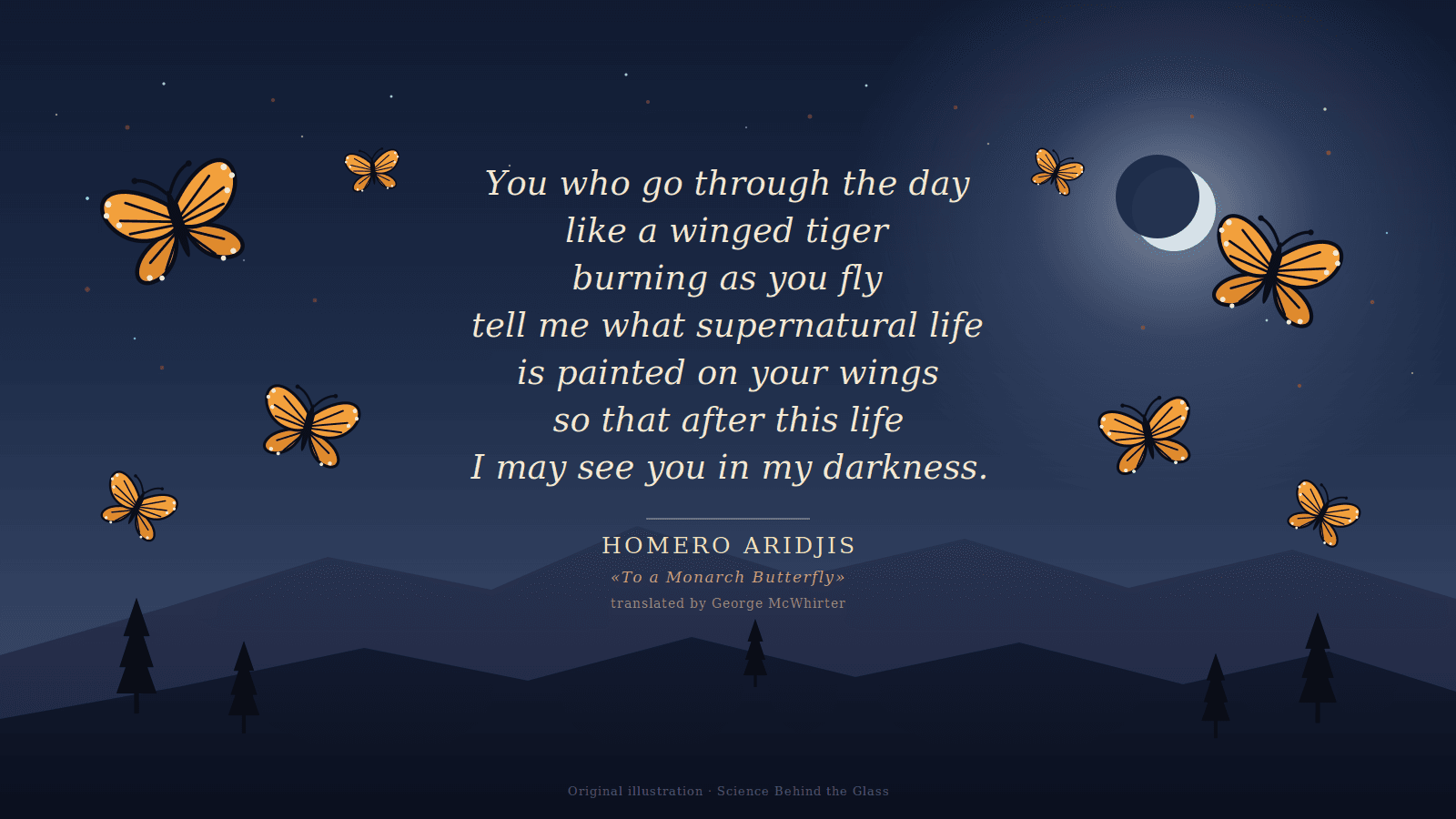
In Mexico, before monarch butterflies had any legal protection, Homero Aridjis — poet, novelist, diplomat and environmental activist — wrote about them. He grew up in Contepec, at the foot of Cerro Altamirano, one of the sites where the monarchs spend the winter, and as a child he saw a deliberately set fire on the butterfly mountain. From that came a lifetime of admiration and defence. In 1985 he founded the Group of 100, made up of artists and intellectuals rather than scientists, to press the Mexican federal government to protect the monarch butterfly’s habitat; as a result, the 1986 decree that formally established the reserve’s boundaries was issued. What science alone had not achieved in decades of warnings was achieved by the pressure of a group of writers.
Rachel Carson, a marine biologist, set a precedent for an entire country when she published Silent Spring in 1962. The first chapter is a fable about an invented town where the birds fall silent. With that opening, Carson used literature to guide her readers towards the scientific evidence. The remaining chapters are the documented evidence on the effects of the pesticide DDT (dichlorodiphenyltrichloroethane), which accumulated in small organisms — fish, molluscs and insects — and moved up the food chain. Large birds accumulated it in their bodies, where it broke down into DDE (dichlorodiphenyldichloroethylene), the compound that causes the thinning of eggshells, which then broke when the eggs were incubated.
And it worked. The United States banned DDT in 1972 and Australia in 1987; residues of the pesticide in Australian butter fell from 4,700 nanograms per gram in 1969 to 8 in 1999, and the birds that had been disappearing recovered. A book that opens with a fable ended up being measured in the chemistry of a supermarket product.
Two conversations
In our Conversar para Conservar special, we sat down with two researchers to talk about something we usually think of as far removed from science: art. Dr Karen Muñoz, director of Van der Steen Solutions, and Dr Alfredo Yáñez, researcher at the Faculty of Sciences of the Autonomous University of Baja California, in Mexico, bring us different perspectives on how to understand our natural world and how to communicate science. Each name links to the full conversation.
With Dr Karen we discussed the fungi exhibition at the Nieuwe Instituut in Rotterdam, Fungi: Anarchist Designers, in which anarchy can arise from the organisms we least expect: fungi. With Dr Alfredo we discovered how poetry describes natural phenomena before science has even named them, and how his profession and narrative converge in understanding natural processes.
All quotations below were spoken in Spanish and have been translated for this English edition.
Dr Alfredo is a poet by nature, and this has been his greatest inspiration. And how could it not inspire, when it takes us back to our origins:
“It is like returning to the origin… since the beginning of humanity, poetry and science stood side by side. In order to explain a phenomenon, because we did not have the words we needed, we used poetry to get closer to it.”
— Dr Alfredo Yáñez
“in science there are many things we cannot name. And in poetry, when we do not know how to name them, we create words, and the act of creating something new is placing it in front of someone’s eyes, whether a reader or a listener. So when something overwhelms us and we cannot find a way to name that feeling, we have to reach for other tools.”
— Dr Alfredo Yáñez
Why art, and not some other field?
“I am completely convinced that the best way to educate is through art, because art makes us feel that moment of catching our breath… And when we feel that, there is a whole set of sensations that stir curiosity in almost all of us, or that make us move, or make us take action.”
— Dr Karen Muñoz
The point is that an exhibition carries no preconditioning the way a classroom does; there is no obligation. People usually go of their own accord, with the wonder and curiosity that characterise us as a species. From there, a person is willing to explore and to learn.
When art connects with us, it does not necessarily do so through logic, but through the subtler parts of who we are: the sensory part. Reasoning comes afterwards.
“it is not a connection of reasoning, but an emotional one, and starting from the emotional, reasoning will come later; but I think that way of reaching the essence of a person so directly is extremely important and extremely powerful for conveying messages.”
— Dr Karen Muñoz
What art does is carry into the sensory world concepts that, from the standpoint of science, often look like an act of faith. We know that DNA is in every cell, but we do not see it.
“I really like to point out that we study microorganisms… I enjoy talking about them because I feel it is an abstract concept — here there is a microorganism, or millions of them, but how can I talk to you about something, and show you something, that you cannot see with the naked eye?”
— Dr Alfredo Yáñez
Connecting science and nature through curiosity can open unexplored avenues. Analogies are our daily bread, and that is how we have described and communicated natural phenomena for centuries.
“We speak, for example, of the lightning bolt that falls, which can be the same as my veins, which can be the path of the ants, which can be the rivers.”
— Dr Alfredo Yáñez
When we learn from nature, as we do from fungi, humility consists in understanding that domination breaks the bond. When we stop, we can learn how nature solves problems.
“Fungi… do not obey the laws we humans set.”
— Dr Karen Muñoz
“we have to be humble and learn from the fungus. As humanity, we have always been trying to dominate nature, and this is a moment in which we have to have the humility to look and to learn, and to stop doing things, and look and learn how nature resolves.”
— Dr Karen Muñoz
The exhibition shows how fungi extend beyond the limits we impose on them, and how, in our daily lives, they live alongside us. But that coexistence is not fixed. Balance is what determines whether a fungus cooperates with another organism or attacks it: the same species that feeds a tree can become its parasite when conditions change. There are no good or bad fungi; there are contexts.
“monocultures are like the perfect place for the pathogenic fungi that damage plants to reproduce so easily”
— Dr Karen Muñoz
Monocultures are the clearest example. When the balance of the soil microbiota is broken, plants stop taking up nutrients efficiently; this is compensated for with more fertiliser, the fertiliser keeps leaching through, yields keep falling, and in the end what is left is infertile soil. And because every plant in the field is the same, a pathogenic fungus that gets in meets nothing to stop it.
We are not the centre
One thing Karen and Alfredo agree on is that, as humans, we are not the centre of everything, but part of the immensity of this planet, and that poetry and art allow us to understand our place in it. When Alfredo travelled to Antarctica in 2026, as part of the first Mexican Antarctic Campaign run by the Mexican Agency for Antarctic Studies (AMEA) together with CIATEJ (the Research and Assistance Centre in Technology and Design of the State of Jalisco), he was left without words on arrival: silence and beauty flooded his senses, allowing him to find inspiration and to understand his own humanity.
“all that whiteness and the cold floods you — it overwhelms you, and you understand that we are one piece inside that small great universe called a planet.”
— Dr Alfredo Yáñez
Who should be telling the science?
Should art that communicates science be led by scientists? The message depends on how well it is conveyed, and the opposite of what is intended can happen. That is why more and more scientists are seeking to collaborate with artists in order to communicate science — or, perhaps, sometimes they become that artist themselves.
“when I finished the exhibition I thought: someone who knows nothing about fungi and comes to this exhibition is going to end up far more afraid of the subject, and that struck me as something that was missing.”
— Dr Karen Muñoz
“I want to make a call for them to please give us the second part of fungi, the beneficial part, which I think is going to be three times bigger.”
— Dr Karen Muñoz
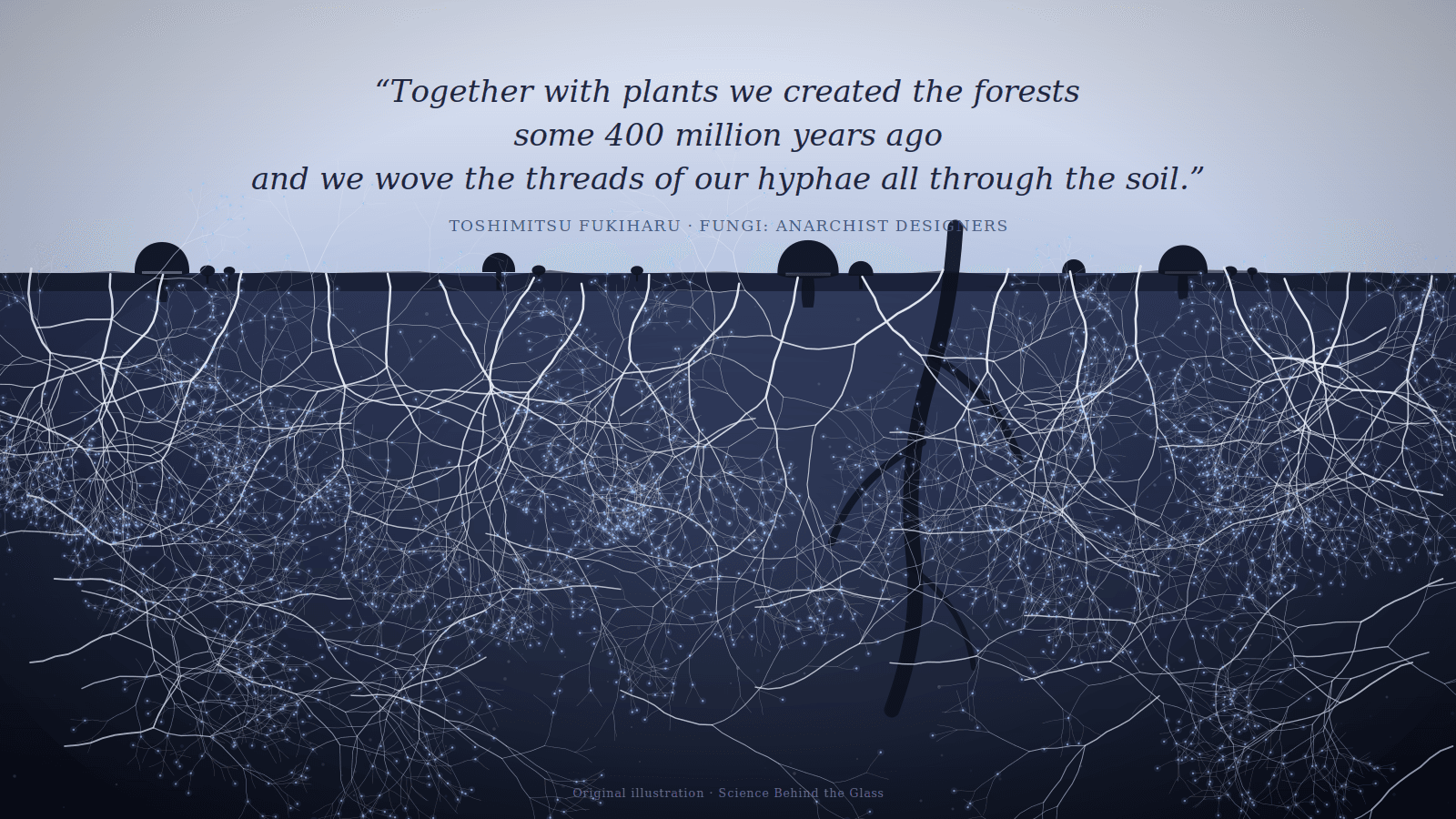
Fungi have been the protagonists of this planet, shaping and creating the conditions that allowed forests to thrive on land, all thanks to mycorrhizae, which supplied minerals in exchange for carbohydrates.
In the Rhynie chert, in Scotland, plants from 407 million years ago were preserved with their cells intact, and inside those tissues mycorrhizal fungi can be seen with their branching structures — the same ones they use today to deliver minerals to the plant. Those first land plants had no roots: the fungi did that work. The symbiosis is older than roots. Plants did not conquer the land and then form an alliance with fungi; they came out of the water already allied.
The whole soil food web works like an orchestra: what you hear depends on the conditions, and with those conditions the rhythm changes.
The protagonist tells us, with its own hyphae, what it thinks:
“We, the fungi, created the forests. Together with plants we created the forests some 400 million years ago. With the plants we came onto land; they spread their roots while they took in the sun, and we wove the threads of our hyphae all through the soil. The animals soon joined us, and forests remain places where countless organisms are born, live and die.”
— Exhibition text, Toshimitsu Fukiharu · read aloud by Karen Muñoz
Science is not enough. Not because it lacks rigour, but because rigour alone moves no one. A meta-analysis published in 2025 in Science Communication, by Choi, Chen and Guo, compared narrative evidence against statistical evidence in environmental communication and found that narrative significantly increases risk perception and the intention to act, while statistics work in a more conditional way, and work far better when framed locally.
Science and art, both driven by curiosity: through art, science is recreated so that it can reach the emotions; and science, as the foundation, extends across many levels. Carson had the data and began with a fable. Aridjis did not lean on the data but on literature, and secured the decree through poetry. Alfredo studies organisms no one can see and writes poems to make them visible. Karen tries it with colours and admits that sometimes she does not know whether it works.
Data do not fail. Data simply do not land on their own. They need a body, a face, a place — a frog that stopped singing, a mountain where the butterflies used to arrive, an animal on the asphalt that only wanted to reach the other side.
And so is all that remains to ask how we reach the eyes and the ears that have not listened to methodical, analytical science?
“But the root does not die. Even though the children move away, the root does not die when the heart of the earth is held together.”
— Dr Alfredo Yáñez
Three ways to name an absence
Three pieces written by people who do science. Not one of them gives a figure.
The two poems by Dr Alfredo Yáñez were written in Spanish and published in Ceiba y lagarto. The English versions below are our own translations, offered so that readers can follow the sense; the Spanish originals are the authoritative text.
The Toads’ Poem · Linda Hernández Durán
We are the voices that compose the melody of the night,
the ones that frighten the darkness away and put enchantment in the moon.
We are the damp throats of the forest,
the first to sing when it rains.
But we are also the voices that are fading out.
Where once there was a chorus, now an echo resounds:
a distant echo, an echo of lament, an echo without a voice.
Written in response to chytridiomycosis, the disease caused by the fungus Batrachochytrium dendrobatidis, which coats the skin of amphibians and prevents them from breathing. It has driven frog species to extinction on every continent where amphibians occur.
Dust Covers the Stories with Silence · Dr Alfredo Yáñez, from Ceiba y lagarto
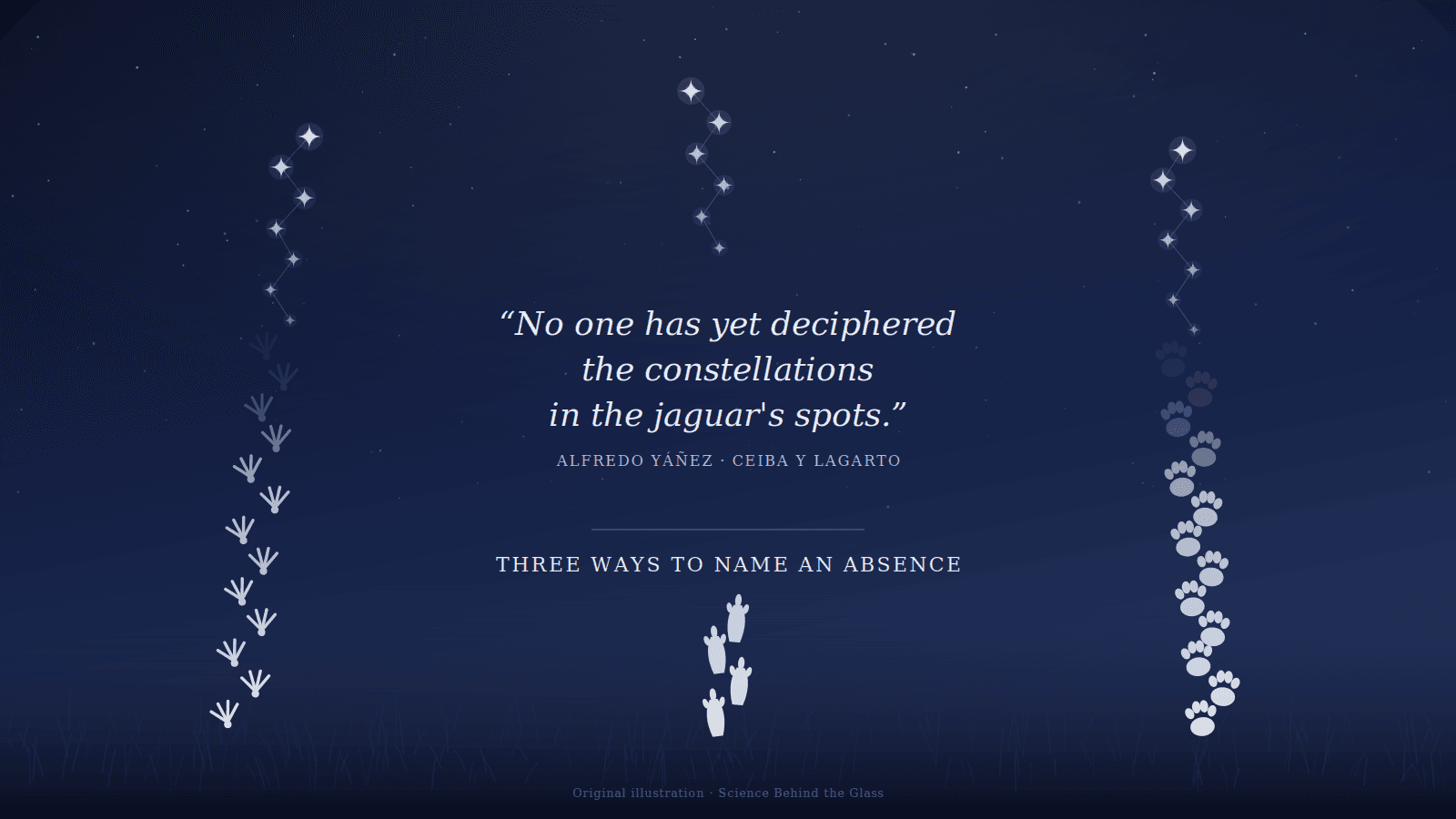
Legends do not die; they are breathed in the jungle, they travel in the bluish voices and tremble in everything liquid in our souls. No one has deciphered the constellations in the jaguar’s markings, nor the dance in the tracks of hunter and prey.
The toads sing to the stars and the elders keep their glow among their wrinkles. Dust covers the untold stories with silence. The ceiba and the lizard will weave shut their eyes and sleep in new ears. Come, come closer. Leave the door open, for in this brief intimacy there is a new beginning.
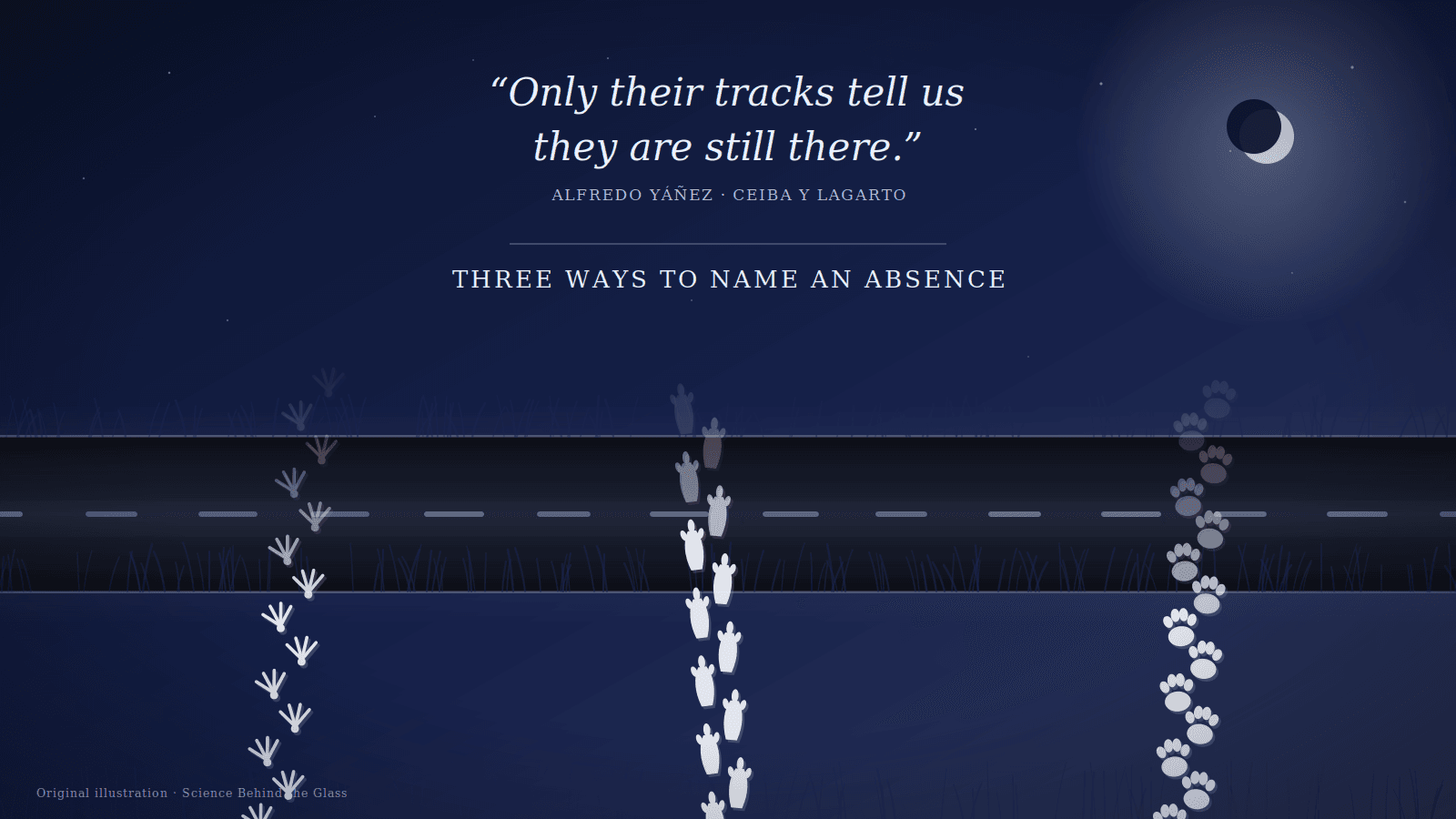
Legends Do Not Die · Dr Alfredo Yáñez, from Ceiba y lagarto
Legends do not die.
The people who tell them die.
The night dies before the light.
The maize dies when it is not its season.
The hunter, when his day comes.
The legs that work the jungle die,
the laughter of the great trees,
the weeping of the wetlands.
The sudden sight of the deer, of the jaguar, of the tapir dies at the bullet’s impact.
Only their tracks tell us they are still there.
The stone uncovered by white hands dies,
the tongue in search of freedom.
But the root does not die.
Even though the children move away,
the root does not die when the heart of the earth is held together.
References
The poems
Yáñez-Montalvo, A. (2022). Ceiba y lagarto. Capítulo Siete, 58 pp. Cover illustration by Liliana Chel-Lilodonte. capitulosiete.com.mx
Rachel Carson and DDT
Carson, R. (1962). Silent Spring. Houghton Mifflin. Full text · Chapter 8, “And No Birds Sing”
United States Environmental Protection Agency (EPA). The Case of DDT: Revisiting the Impairment. epa.gov
Historic Trends in the Concentrations of Persistent Organohalogenated Pollutants in Australian Butter (2025). ACS Omega. Full text
Homero Aridjis and the Group of 100
“A una mariposa monarca” (To a Monarch Butterfly). New York Public Library · Earth Charter
Ambientalismo en Homero Aridjis. Biblioteca Virtual Miguel de Cervantes. cervantesvirtual.com
Sharp and Wright. “We Were in Love with the Forest”: Protecting Mexico’s Monarch Butterfly Biosphere Reserve. Forest History Society. foresthistory.org
The exhibition
FUNGI: Anarchist Designers. Nieuwe Instituut, Rotterdam. nieuweinstituut.nl
Fungi and forests
An arbuscular mycorrhiza from the 407-million-year-old Windyfield Chert. Full text
Science communication
Choi, S., Chen, M. and Guo, Z. (2025). “Narrative Versus Statistical Evidence in Environmental Persuasion: A Meta-Analysis”. Science Communication. journals.sagepub.com
The episodes

